

Last weekend, I played UIUCTF 2024 with my team thefwncrew. My team finished top 16 in this CTF.

I solved all Cryptography challenges, and 1 misc challenge. Here is my writeup for challenges that are solved by me.
MISC
Slot Machine
We have onboard entertainment! Try your luck on our newly installed slot machine.
ncat --ssl slot-machine.chal.uiuc.tf 1337
Downloads
Solution
This challenge asks me for a hex string such that it has longest prefix collision in SHA256
hash = sha256(bytes.fromhex(lucky_number)[::-1]).digest()[::-1].hex()

length = min(32, int(input("How lucky are you feeling today? Enter the number of slots: ")))

if len(set(hash[:length])) == 1:
    print("Congratulations! You've won:")
    flag = open("flag.txt").read()
    print(flag[:min(len(flag), length)])
else:
    print("Better luck next time!")
Then I found the site: https://crypto.stackexchange.com/questions/110956/what-s-the-smallest-known-sha256-hash-that-was-ever-produced and its hash is 0000000000000000000000005d6f06154c8685146aa7bc3dc9843876c9cefd0f
After that you can use this command to find the block https://github.com/sylvainpelissier/bitcoinhash
python3 bitcoinHash.py -v -u  https://blockchain.info/rawblock/0000000000000000000000005d6f06154c8685146aa7bc3dc9843876c9cefd0f

f5b209498bfad650eb000b1917fc119b601e799c18c00b6e562e71300ed1cc93
0ffdcec9763884c93dbca76a1485864c15066f5d000000000000000000000000
from pwn import *

io = process(["ncat", "--ssl", "slot-machine.chal.uiuc.tf", "1337"])

test = "f5b209498bfad650eb000b1917fc119b601e799c18c00b6e562e71300ed1cc93"
test = bytes.fromhex(test)[::-1]

io.sendlineafter(b"number: ", test.hex().encode())
io.sendlineafter(b"slots: ", b"24")
io.interactive()
FLAG
uiuctf{keep_going!_3cyd}
Cryptography
X Marked the Spot
A perfect first challenge for beginners. Who said pirates can’t ride trains…
Downloads
Solution
Simple xor problem so i just put my script here.
from pwn import *

from Crypto.Util.number import *

ct = open("ct", "rb").read()
test = b"uiuctf{"
key = xor(ct, test)[:7] + xor(b'}', ct[-1])

print(xor(key, ct))
FLAG
uiuctf{n0t_ju5t_th3_st4rt_but_4l50_th3_3nd!!!!!}
Without a Trace
Gone with the wind, can you find my flag?
ncat --ssl without-a-trace.chal.uiuc.tf 1337
Downloads
Solution
This challege encodes FLAG into a 5x5 matrix (L).
f = [bytes_to_long(bytes(FLAG[5 * i: 5 * (i + 1)], 'utf-8')) for i in range(5)]
F = [
    [0, 0, 0, 0, 0],
    [0, 0, 0, 0, 0],
    [0, 0, 0, 0, 0],
    [0, 0, 0, 0, 0],
    [0, 0, 0, 0, 0],
]
for i in range(5):
    F[i][i] = f[i]
Then it takes L times M which is a 5x5 matrix which input being the data we choose.
def inputs():
    print("[WAT] Define diag(u1, u2, u3. u4, u5)")
    M = [
        [0, 0, 0, 0, 0],
        [0, 0, 0, 0, 0],
        [0, 0, 0, 0, 0],
        [0, 0, 0, 0, 0],
        [0, 0, 0, 0, 0],
    ]
    for i in range(5):
        try:
            M[i][i] = int(input(f"[WAT] u{i + 1} = "))
        except:
            return None
    return M
The data we choose must match the challenge’s conditions.
def check(M):
    def sign(sigma):
        l = 0
        for i in range(5):
            for j in range(i + 1, 5):
                if sigma[i] > sigma[j]:
                    l += 1
        return (-1)**l

    res = 0
    for sigma in permutations([0,1,2,3,4]):
        curr = 1
        for i in range(5):
            curr *= M[sigma[i]][i]
        res += sign(sigma) * curr
    return res

 if check(M) == 0:
    print("[WAT] It's not going to be that easy...")
    return
Finally, Challenge returns us the diagonal sum of the matrix L * M.
Basically, we know that
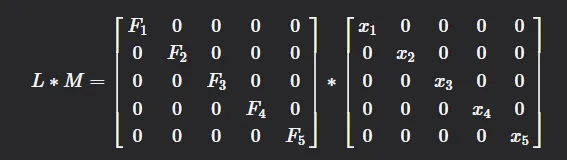
And we are received
If we have 5 equations like that, we can recover FLAG
from sage.all import *
from Crypto.Util.number import *

M = Matrix([[2, 1, 1, 1, 1], [1, 2, 1, 1, 1], [1, 1, 2, 1, 1], [1, 1, 1, 2, 1], [1, 1, 1, 1, 2]])

M = M.inverse()

res = Matrix([2504408575853, 2440285994541, 2426159182680, 2163980646766, 2465934208374])

res = res * M
FLAG = b""
for i in res[0]:
    FLAG += long_to_bytes(int(i))

print(FLAG)
FLAG
uiuctf{tr4c1ng_&&_mult5!}
Determined
”It is my experience that proofs involving matrices can be shortened by 50% if one throws the matrices out.”
Downloads
Solution
In sagemath, we can use symbolic to guess the output of the function.
I use are variables and after some tries, I choose 0 for the first row and 1 for others. Then the server will give me
from sage.all import *
from Crypto.Util.number import *

test = 69143703864818353130371867063903344721913499237213762852365448402106351546379534901008421404055139746270928626550203483668654060066917995961156948563756763620082694010964627379305998217766380375890208111586340805642016329892173840181871705216180866148524640933007104761115889694872164169659985765092765835334
n = 158794636700752922781275926476194117856757725604680390949164778150869764326023702391967976086363365534718230514141547968577753309521188288428236024251993839560087229636799779157903650823700424848036276986652311165197569877428810358366358203174595667453056843209344115949077094799081260298678936223331932826351
e = 65535
c = 72186625991702159773441286864850566837138114624570350089877959520356759693054091827950124758916323653021925443200239303328819702117245200182521971965172749321771266746783797202515535351816124885833031875091162736190721470393029924557370228547165074694258453101355875242872797209141366404264775972151904835111

test = n - test
p = gcd(test, n)
q = n // p
phi = (p - 1) * (q - 1)
d = inverse(e, phi)
FLAG = pow(int(c), int(d), int(n))
print(long_to_bytes(FLAG))
FLAG
uiuctf{h4rd_w0rk_&&_d3t3rm1n4t10n}
Naptime
I’m pretty tired. Don’t leak my flag while I’m asleep.
Downloads
Solutions
It’s the basic Subset Sum Problem so I just put my script here.
from sage.all import *
from Crypto.Util.number import *

a =  [66128, 61158, 36912, 65196, 15611, 45292, 84119, 65338]
ct = [273896, 179019, 273896, 247527, 208558, 227481, 328334, 179019, 336714, 292819, 102108, 208558, 336714, 312723, 158973, 208700, 208700, 163266, 244215, 336714, 312723, 102108, 336714, 142107, 336714, 167446, 251565, 227481, 296857, 336714, 208558, 113681, 251565, 336714, 227481, 158973, 147400, 292819, 289507]

FLAG = b""
for i in ct:
    M = Matrix(ZZ, 9, 9)
    for j in range(8):
        M[j, j] = 2
        M[j, -1] = a[j]
        M[-1, j] = 1

    M[-1, -1] = i
    M = M.LLL()
    bits = ""
    for j in M[0][:-1]:
        if j == 1:
            bits += "0"
        else:
            bits += "1"
    FLAG += long_to_bytes(int(bits, 2))

print(FLAG)
FLAG
uiuctf{i_g0t_sleepy_s0_I_13f7_th3_fl4g}
Snore Signatures
These signatures are a bore!
ncat --ssl snore-signatures.chal.uiuc.tf 1337
Downloads
Solutions
When we look deeply into the function
def snore_sign(p, q, g, x, m):
    k = randint(1, q - 1)
    r = pow(g, k, p)
    e = hash((r + m) % p) % q
    s = (k + x * e) % q
    return (s, e)
We see that server don’t verify the messages, so we send and respectively to server.
from pwn import *

io = process(["ncat", "--ssl", "snore-signatures.chal.uiuc.tf", "1337"])
context.log_level = b''
p = eval(io.recvline().strip().split(b"=")[1])
q = eval(io.recvline().strip().split(b"=")[1])
g = eval(io.recvline().strip().split(b"=")[1])
for i in range(10):
    io.sendlineafter(b"m = ", str(i).encode())
    s = eval(io.recvline().strip().split(b"=")[1])
    e = eval(io.recvline().strip().split(b"=")[1])
    io.sendlineafter(b"m = ", str(i + p).encode())
    io.sendlineafter(b"s = ", str(s).encode())

io.interactive()
FLAG
uiuctf{add1ti0n_i5_n0t_c0nc4t3n4ti0n}
Groups
My friend told me that cryptography is unbreakable if moduli are Carmichael numbers instead of primes. I decided to use this CTF to test out this theory.
ncat --ssl groups.chal.uiuc.tf 1337
Downloads
Solutions
This problem we just generate Carmichael numbers and send it to server.
from sage.all import *
import operator

first_primes = list(primes(10**7))

factors = [2**3, 3, 5, 7, 11, 13, 17]
lam = reduce(operator.mul, factors)

P = []
for p in primes(min(10000000, lam)):
    if p < 400:
        continue
    if lam % p and lam % (p - 1) == 0:
        P.append(p)

prodlam = reduce(lambda a, b: a * b % lam, P)
prod = reduce(lambda a, b: a * b, P)

proof.arithmetic(False)

while 1:
    numlam = 1
    num = 1
    for i in range(20):
        p = choice(P)
        numlam = numlam * p % lam
        num = num * p
        if numlam != prodlam or prod % num != 0:
            continue
        q = prod // num
        print("candidate", q)
        print(factor(q))
        break
Now, we have q and easily solve this problem by discrete_log in sagemath
FLAG
uiuctf{c4rm1ch43l_7adb8e2f019bb4e0e8cd54e92bb6e3893}
Key in a Haystack
I encrpyted the flag, but I lost my key in an annoyingly large haystack. Can you help me find it and decrypt the flag?
Downloads
Solutions
If you know about birthday paradox, you will solve this challenge.
I save all state of haystack and find the gcd of new haystack with all old haystacks. Finally i can find all 300 primes in haystack and have the key.
from Crypto.Util.number import getPrime
from Crypto.Util.Padding import pad
from Crypto.Cipher import AES
from sage.all import *


from hashlib import md5
from math import prod
import sys
from pwn import *

sys.set_int_max_str_digits(0)

lists = []
haystack = 0
enc = 0
cnt = 0
while True:

    # io = process(["python3", "chal.py"])
    io = process(["ncat", "--ssl", "key-in-a-haystack.chal.uiuc.tf", "1337"])
    # context.log_level = 'DEBUG'
    print(cnt)
    cnt += 1
    enc = io.recvline().strip().split(b":")[1][1:].decode()
    haystack = eval(io.recvline().strip().split(b":")[1][1:])
    save = haystack
    for i in range(len(lists)):
        key = gcd(haystack, lists[i])
        if key == 1:
            continue
        if haystack != 1 and len(bin(haystack)[2:]) <= 50:
            print(haystack)
            print(len(bin(haystack)[2:]))
            FLAG = AES.new(
	            key = md5(b"%d" % haystack).digest(),
	            mode = AES.MODE_ECB
            ).decrypt(bytes.fromhex(enc))
            print(FLAG)
            exit()

        haystack = haystack // key
    if cnt > 15:
        print(len(bin(haystack)[2:]))
        if len(bin(haystack)[2:]) < 3000:
            print(haystack)
            print(enc)

    lists.append(save)
    io.close()
FLAG
uiuctf{Finding_Key_Via_Small_Subgroups}